
AI – Artificial Intelligence
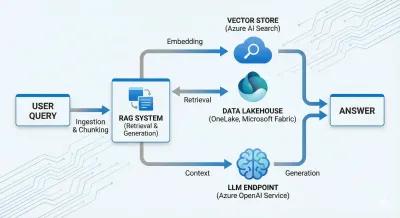
RAG over company data
Want to deploy generative AI on top of your company's own know-how without the risk of hallucinations? This technical deep dive into RAG architecture shows that AI success stands and falls with quality data engineering and data architecture. Explore how to build a modern data platform for AI based on Microsoft Fabric and Azure Data Lakehouse and how to overcome the challenges of data vectorization, security, and transition to a production enterprise environment.
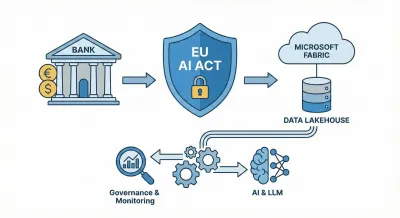
AI Governance in the Financial Sector
Artificial intelligence is becoming a key tool in the financial sector for risk management, credit scoring, and decision-making automation—but it is also attracting increasing attention from regulators. The new EU AI Act and AI governance principles provide banks and insurance companies with clear rules on how to design, operate, and monitor AI so that it is transparent, auditable, and ethically responsible. This article summarizes the main impacts of the regulation on financial institutions and demonstrates how to effectively implement AI governance on a modern data platform.
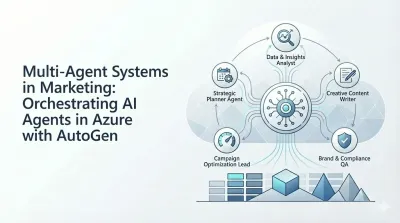
Multi-agent systems in marketing
Multi-agent systems are shifting marketing work from one-off text generation to an "AI team" of specialized agents who share roles (planning, analysis, content creation, quality control) and collectively deliver consistent results. When combined with Microsoft Azure and the AutoGen framework, these agent workflows can be securely operated, scaled, and integrated into corporate data and marketing channels. The result is faster campaign preparation, more variants and iterations in less time, better control over tone of voice and compliance, and a higher degree of personalization thanks to working with segments and performance data. At the same time, risks (inconsistencies, latency, costs, debugging) must be managed using shared context, templates, agent QA/“reviews,” and robust logging. The most practical way to start is with 1–2 “low-hanging fruit” scenarios with clear KPIs (e.g., generating campaign variants, virtual focus groups, assisted personalization) and gradually expanding from a POC to production deployment.
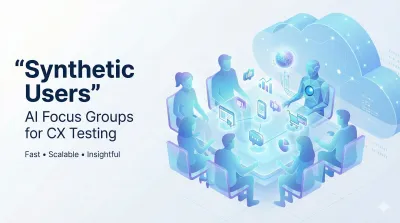
Synthetic Users and AI Focus Groups
Synthetic users and AI focus groups offer a new way to quickly and scalably validate ideas related to the customer experience without the complex logistics of traditional research. Digital personas based on modern language models enable you to simulate how different segments react to a product, messaging, pricing, and changes in the customer journey, and to uncover barriers to understanding or trust before implementation. Data Mind’s Agora AI tool brings this approach to life: it “brings your segmentation to life” in the form of personas, leads virtual focus groups on real-world scenarios, and provides structured outputs for CX and product team iterations.

AI Governance and the EU AI Act
The EU AI Act shifts the governance of artificial intelligence from the realm of "best practices" to a framework of measurable obligations—particularly for high-risk systems that affect customers or employees. This article outlines a practical approach to implementing AI governance within a company: from conducting an AI inventory and risk classification, through defining roles, internal policies, and approval processes, to technical measures for monitoring, audit trails, security, and the controlled deployment of LLMs in the Azure environment. The result is a framework that reduces both regulatory and reputational risks while enabling the scaling of AI into production processes without losing control.

TOON: A New Format for Professional Prompt Notation (And Why It’s Not Just “Another JSON”)
The TOON (Token-Oriented Object Notation) format is a new way of representing structured data designed with LLMs in mind—particularly in cases where prompts contain large amounts of tabular data or the state of multi-agent systems. It maintains semantic compatibility with JSON but represents data more concisely and readably: less syntactic “noise,” the ability to represent homogeneous arrays in tabular form, and natural handling of indentation. The article demonstrates when TOON makes sense as a professional format for prompts, when JSON remains the better choice, and what risks the novelty of the standard and the more limited ecosystem of tools entail.