
Server-Side Tracking
Analytics in the Age of Privacy
Why browser-side measurement is reaching its limits
Digital analytics is undergoing a fundamental transformation. The gradual phase-out of third-party cookies, more aggressive script blocking in modern browsers (Safari, Firefox, and eventually Chrome), and growing pressure to protect personal data are significantly reducing the quality of traditional client-side measurement. The result is incomplete marketing data, underestimated conversions, and a limited ability to accurately evaluate the return on investment in digital channels.
For organizations that rely on data to manage marketing, sales, or the customer experience, this situation is becoming a strategic problem. This is where server-side tracking (SST) comes into play as a key building block of modern data architecture.
What is server-side tracking
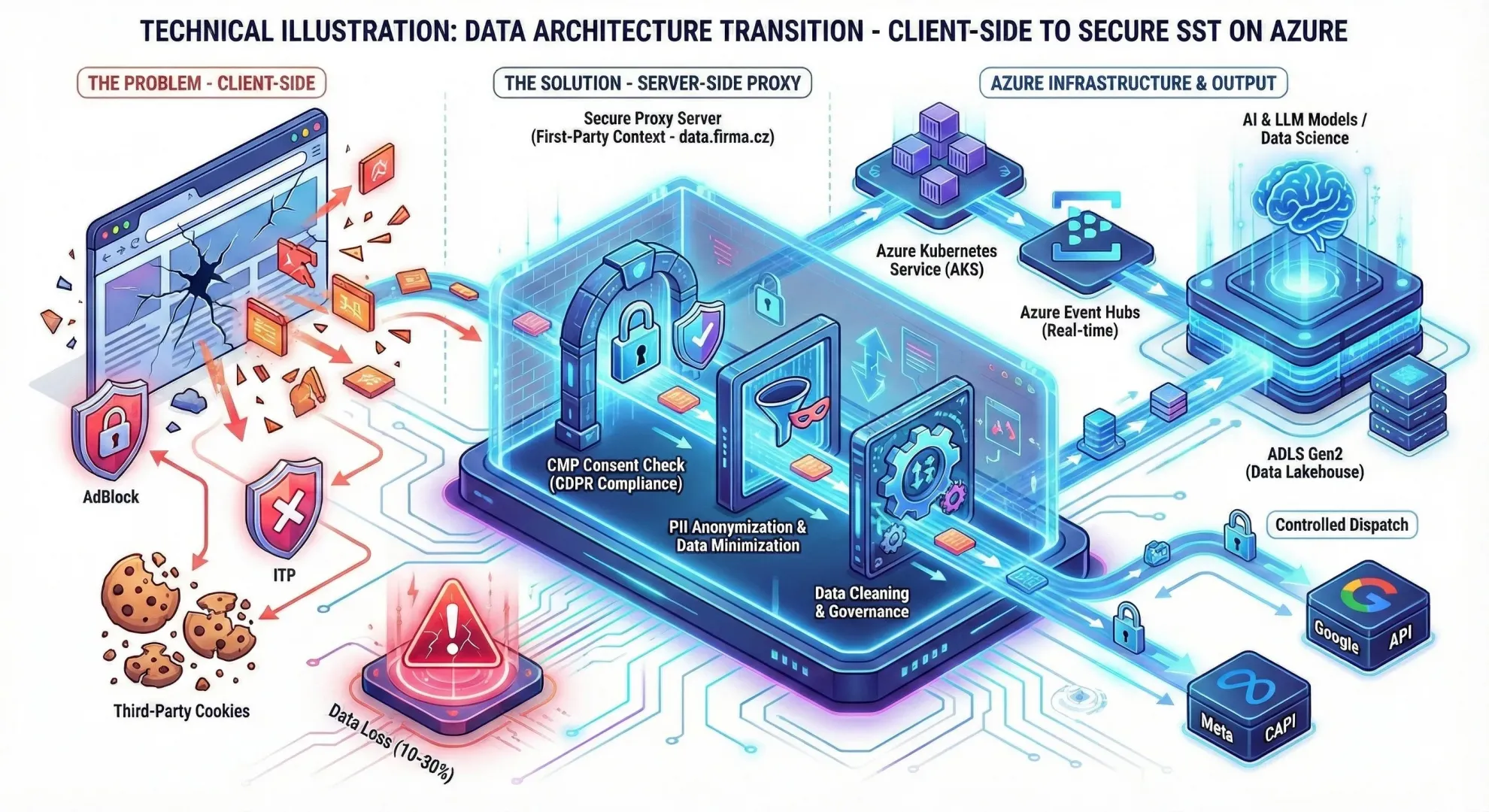
Server-side tracking is an approach to collecting analytical and marketing data in which events from a website or application are not sent directly from the browser to third-party tools, but first to a server controlled by the organization. This server then determines what data, in what format, and where it will be forwarded—for example, to Google Analytics, advertising platforms, CRM systems, or a data warehouse.
Unlike traditional client-side measurement, this gives the company full control over data flows, the ability to centrally manage user consent, and significantly improves both the quality and consistency of the data.
Key Benefits of the Server-Side Approach
Higher data quality and completeness
One of the biggest benefits of SST is a significant reduction in data loss caused by script blocking, browser restrictions, or short cookie lifespans. Server-side communication takes place outside the reach of ad blockers and restrictions such as Intelligent Tracking Prevention, leading to a significantly higher rate of captured conversions and events. For businesses, this means more accurate marketing analytics and more reliable data for decision-making.
Preparing for a world without cookies
Server-side tracking is the natural solution to the so-called "cookieless future." By using first-party domains and server-side data processing, reliance on third-party cookies can be significantly reduced. Combined with tools like Consent Mode, SST enables analytical continuity even in environments where users reject marketing cookies.
Improved website performance and user experience
By moving a large portion of the measurement logic to the server, the number of scripts running in the browser is reduced. This has a positive impact on page load speed, Core Web Vitals, and overall user experience. Website performance thus becomes a secondary, yet very tangible, benefit of server-side measurement.
Security and Privacy
From the perspective of the GDPR and data privacy in general, SST represents a significant step forward. Data can be filtered, anonymized, or enriched on the server before being sent to external systems. This allows organizations to minimize the risk of transferring sensitive data and gain a clearly auditable overview of what data is leaving their infrastructure.
Technology and Architecture
The most widely used tool today is Google Tag Manager Server-Side, which functions as a server-side container typically running in a cloud environment. An alternative is a custom implementation based on serverless services, such as Azure Functions or AWS Lambda.
In the context of a modern data platform, server-side tracking can naturally be integrated with cloud analytics, a data warehouse, or a lakehouse architecture. Web events can thus become a standardized data source that feeds into Microsoft Fabric, a data warehouse, or advanced analytical and AI scenarios.
Risks and Limitations
Server-side tracking is not a one-size-fits-all solution that comes at no cost. Implementing it requires technical expertise, collaboration with the IT department, and the operation of your own infrastructure. This entails a higher initial investment as well as ongoing operational costs.
Another aspect is the increased complexity of debugging and monitoring. Errors no longer manifest directly in the browser but at the server level, which places greater demands on observability and operational discipline.
When does SST make sense
Server-side tracking is particularly beneficial for organizations that:
-
are heavily reliant on high-quality marketing and customer data,
-
is facing significant data loss due to the blocking of cookies and scripts,
-
operates in a regulated environment with an emphasis on privacy protection,
-
They are building a modern data platform and aim to integrate web analytics with a data warehouse, BI, and AI.
For smaller projects, SST may be unnecessarily complex. For medium-sized and larger organizations, however, it represents a strategic investment in the long-term sustainability of analytics.
Conclusion
Server-side tracking is not merely a technical optimization, but a shift in how we approach data. In an era marked by the end of cookies, increasing regulatory requirements, and pressure for data accuracy, it is becoming a key element of modern data architecture. For organizations that want to base their decision-making on high-quality data, SST offers a way to maintain control, credibility, and a competitive advantage.