
Propensity to Buy
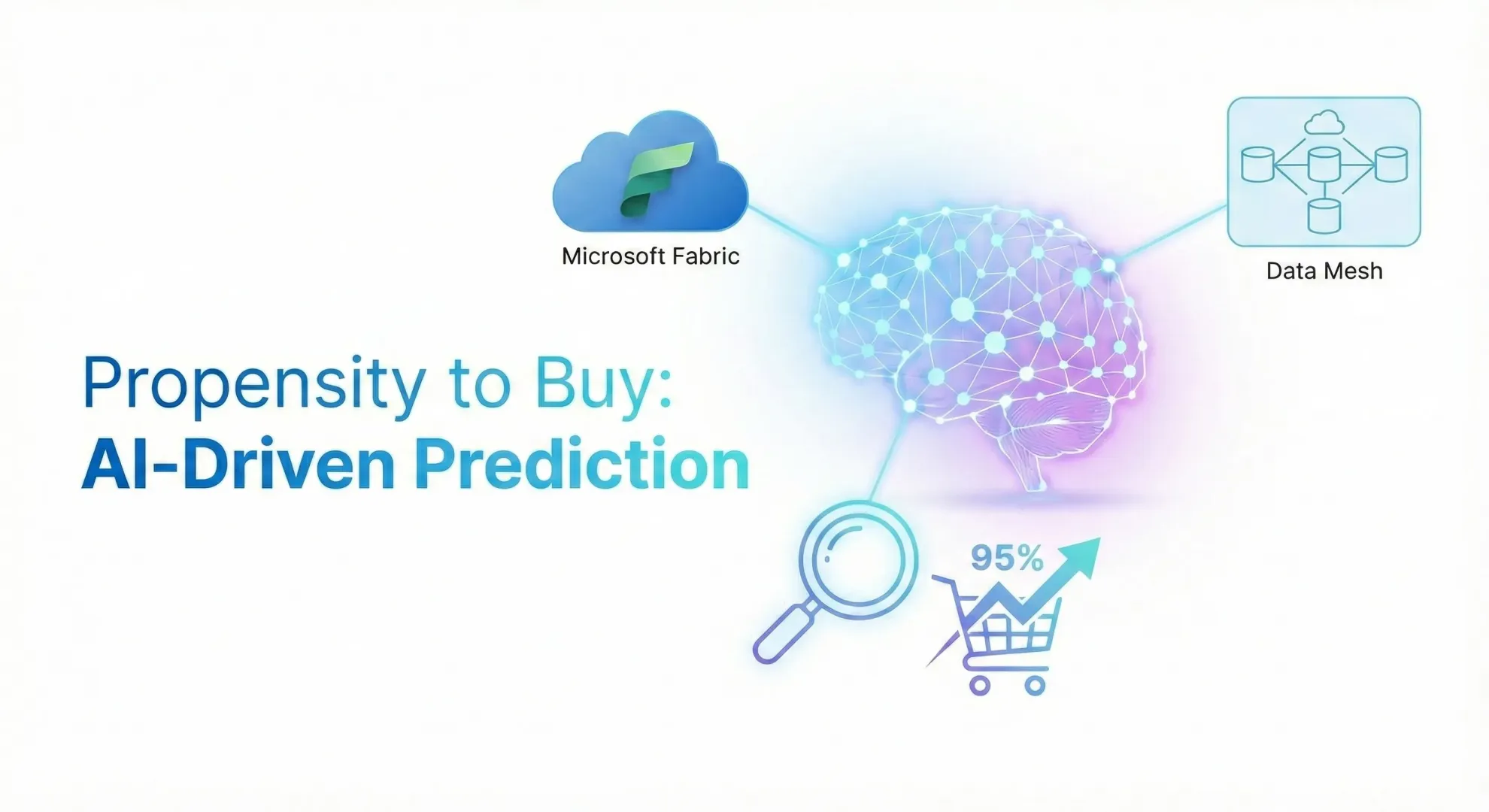
The architecture of predicting purchasing behavior in the era of Data Mesh and Microsoft Fabric
In modern data science, the question is no longer whether to predict customer behavior, but how to scale, refine, and integrate these predictions in real time. The Propensity to Buy model is one of the key use cases for data monetization. For technical managers and data architects, however, this model is not just about choosing the right algorithm, but above all a challenge in the field of data architecture and engineering.
This article focuses on the technical background of implementing the Propensity to Buy model in a cloud analytics environment, specifically on the Microsoft Azure and Microsoft Fabric platforms.
From historical reporting to predictive modeling
Traditional data warehouses have historically been used primarily for descriptive analytics—that is, looking at what has happened. However, for effective marketing targeting, we need to move to prescriptive and predictive analytics.
While classic RFM (Recency, Frequency, Monetary) models segment customers based on past behavior, Propensity to Buy models use machine learning to estimate the likelihood of future conversion. For this estimate to be accurate, it requires a robust modern data platform capable of ingesting and processing heterogeneous data.
Lakehouse as a foundation
The quality of predictions is directly proportional to the quality of the data pipeline. Transaction data from ERP alone is no longer sufficient for training a purchase propensity model. It is necessary to integrate:
-
Behavioral data from the website (clickstream).
-
Interactions from customer support.
-
Unstructured data (texts, logs).
This is where Data Lakehouse architecture comes in, combining the flexibility of data lakes (for unstructured data) with the governance and structure of data warehouses. This approach is native to the Microsoft Fabric ecosystem. It allows you to unify data in Delta Parquet format (OneLake), which can be used to run both SQL queries for BI and Spark jobs for Data science.
For larger organizations, it is advisable to consider the principles of Data Mesh. Instead of a single monolithic team managing all data, domain teams (e.g., e-commerce, sales, marketing) are responsible for their data as a product. The Propensity to Buy model then consumes this data through defined contracts, which increases development agility.
Feature Engineering and Model Selection
During the primary data analysis and subsequent feature engineering phase, raw data is transformed into signals. Typical features for a susceptibility model include:
-
Moving averages of spending.
-
Time since the last visit to a specific category of the website.
-
Slope of the purchase frequency curve (trend).
From an algorithmic perspective, methods based on decision trees and gradient boosting (XGBoost, LightGBM), which are part of the standard libraries in Azure Machine Learning, have proven to be the most effective for tabular data.
The role of AI and LLM in modern prediction
A new trend is the integration of AI & LLM (Large Language Models) into the process. LLM can be used in two phases:
-
Input enrichment: Sentiment analysis of call center notes or emails using NLP, which creates a new feature for the predictive model.
- Explainability and personalization: While XGBoost determines who will buy, LLM can generate personalized marketing copy based on customer attributes that explains why the product is relevant to that customer.
Orchestration and MLOps in Microsoft Fabric
A key aspect for deploying the model into production is MLOps (Machine Learning Operations). In the Microsoft Fabric environment, the entire model lifecycle is integrated:
-
Data Engineering: Preparing data using Data Factory pipelines to Lakehouse.
-
Experimentation: Training models on laptops using MLflow for experiment tracking.
- Deployment: Model registration and batch inference that scores the entire customer base daily/weekly.
-
Monitoring: Monitoring data drift (changes in data distribution over time) that could degrade model performance.
The output of the model is a score (0-1) that is written back to the marketing segments in the CRM or CDP platform.
Data monetization through advanced analytics
Implementing the Propensity to Buy model is not a one-time project, but a process of continuous learning. It requires a solid infrastructure (cloud analytics), advanced machine learning know-how, and the ability to connect the world of data with the world of business.
As a certified Microsoft partner, Data Mind helps companies build these modern data platforms. Whether you are designing a data warehouse, migrating to Microsoft Fabric, or performing advanced price optimization and targeting, the key to success is an architecture that allows your data to earn money.