
Online segmentation of website visitors to boost the performance of AAA Auto campaigns
AAA Auto needed to better understand who was actually driving traffic to their website—and which types of visitors had a genuine intention to purchase.
At Data Mind, we therefore used web behavioral data to create a segmentation model that distinguished “buyers” from the majority of casual visitors and translated this distinction into concrete marketing decisions.
The result was 10 clearly defined segments and a practical guide on how to improve targeting, offers, and audience exclusion to enhance campaign effectiveness and drive subsequent sales.
Interactive BI dashboards
Comprehensive Power BI solutions—data model design, production reporting, and data visualization in Power BI and Fabric
Automation of reporting
integration with CRM systems, databases, and analytics tools
Business Intelligence Systems
Analysis of KPIs, customer segments, and trends
Data Modeling
Model optimization for Power BI, DAX logic, performance, and scalability
Statistical data analysis
detailed analytical reports and trend analysis
Not every visit is valuable. Segmentation will show you where to invest.
Key findings
10 visitor segments
based on purchase intent
300+ behavioral attributes
analyzed from web data
ROI > 5 within 180 days
thanks to more precise campaign targeting

Do you want to boost your marketing ROI? Visitor segmentation will show you where to invest.
Discuss the project without obligationProject Context
AAA Auto wanted to better distinguish between website visitors based on their actual purchasing intent. The website generated a high volume of traffic, but the marketing team lacked a tool that would allow them to distinguish between visitors genuinely interested in making a purchase and those who were simply browsing the car listings.
Segmentation was intended to enable the marketing team to better manage campaigns, target investments more accurately, and increase conversions within the sales funnel.
The website had a wide reach, but without segmentation, the budget was spread too thinly across visitors who weren’t there to make a purchase but just to browse, and there was a lack of clear prioritization.
Key Challenges
- apply the analytical model to marketing practice
- identify signals of purchase intent from web behavior
- identify stable segmentation dimensions
- determine the optimal number of segments

Data Mind Solutions
We analyzed website visitor behavior and identified more than 300 behavioral attributes that describe their interactions with the website.
The result was a segmentation model based on visitors' online behavior.
The procedure included:
- web behavior analysis
- selection of relevant attributes
- definition of segmentation dimensions
- mathematical optimization of the number of segments
- segment profiling and interpretation
Results
- 10 segments with the following characteristics
- High potential: segments 7, 10, 2
- Low potential: 1, 3, 6
- Special offer: segments 4, 5
- Buyers vs. "lukewarm" customers
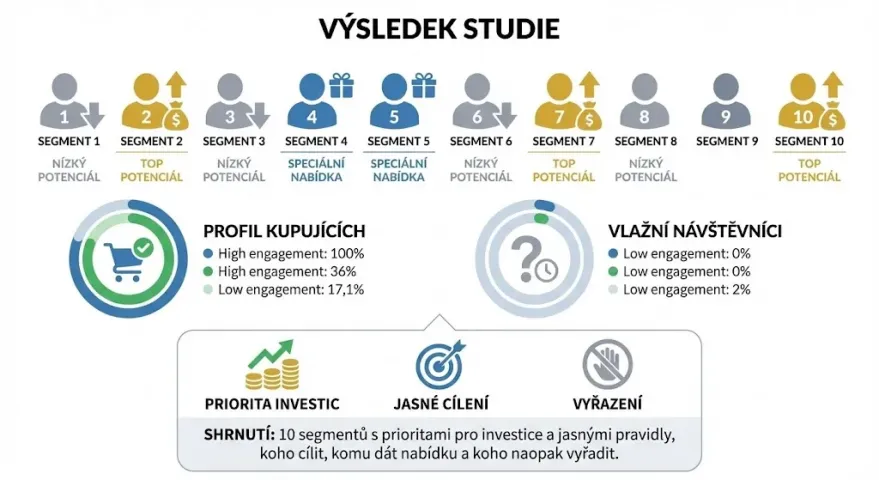
The result was 10 segments with investment priorities and clear guidelines on who to target, who to make an offer to, and who to exclude.
= more precise campaign targeting, better decision-making regarding marketing investments, and significantly greater marketing budget efficiency

Technologies Used
- Microsoft ecosystem
- Customer segmentation
- Optimization of Dimensions and Clusters
- Web behavioral data
- Using Insights for Marketing Targeting
The solution was built on the Microsoft stack and statistical modeling, which ensured reliable segmentation and its integration into marketing tools.
Benefits
- Greater campaign effectiveness
- Significant impact in the first month
- ROI > 5 within 180 days
- Allocation of funds to high-potential visitors
- A better understanding of visitor and actual customer behavior

The project delivered a quick return on investment, increased campaign effectiveness, and more informed decisions about where to allocate the budget and where to cut costs.
Not every visit is equally valuable. Find out who’s worth targeting.
Want to go deeper? Dive into our knowledgebase

Customer 360
Creating a unified Customer 360 profile is not just a marketing goal, but a complex architectural challenge. This article analyzes the necessary transition to Data Lakehouse architecture in the Microsoft Fabric and Azure ecosystem. Learn how to build a modern data platform that serves as a robust foundation for advanced cloud analytics and hyper-personalized communications using AI and LLM.
RAG over company data
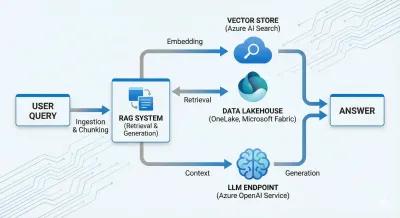
Want to deploy generative AI on top of your company's own know-how without the risk of hallucinations? This technical deep dive into RAG architecture shows that AI success stands and falls with quality data engineering and data architecture. Explore how to build a modern data platform for AI based on Microsoft Fabric and Azure Data Lakehouse and how to overcome the challenges of data vectorization, security, and transition to a production enterprise environment.

Propensity to Buy
How can raw data be transformed into accurate predictions of purchasing behavior? The Propensity to Buy model represents the gold standard of data monetization, but its success stands or falls on the chosen architecture. In this article, we will explore the technical background of implementation in Microsoft Fabric and Azure environments. Learn how to leverage Data Lakehouse principles, advanced machine learning, and generative AI to identify customers with the highest potential—and how to orchestrate it all in a modern, scalable infrastructure.